






Enthral your senses as you embark on the Kathai, Kalai, Parampariyam Curated Walk, where the art becomes a sutradhar (narrator) and will take you on a treasured journey of Indian mythology and more. Come, look into the contemporary prism of the past and the present of Chennai.
The most spectacular among these pays homage to the legendary Dasavataram, the ten incarnations of Lord Vishnu. The Dasavataram earliest mention can be tracked to Mamallapuram (Mahabalipuram). It appears as an inscription on the lintel above the figure of Lord Shankaranarayana in the Adivaraha temple and dates back to the 7th century AD.
It is believed that the Lord has, in his different forms (avatars), come to Earth to restore the balance between good and evil by preserving the supremacy of goodness in the world. Representations of these ten avatars, from the benevolent Matsya to the mighty Kalki, can be seen at different locations around the Centre. Each installation is an interpretation of the legend associated with it and tells a beautiful story
The Fish
Kalarings Studio | Metal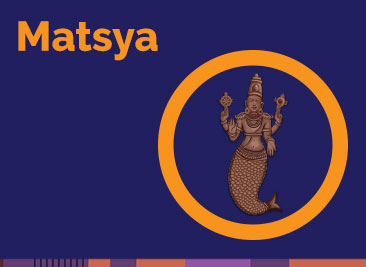
Satyavrata, the king of pre-ancient Dravida and a devotee of Vishnu, (later known as Manu) was washing his hands in a river when a little fish swims into his hands and pleads for protection from other bigger fish. He puts it in a jar, which it soon outgrows. He then moves it to a tank, a river and then finally the ocean but to no avail. The fish then reveals himself to be Vishnu, thanks him for his benevolence and warns the king of a deluge. The fish advises the king to build an ark, one that can be attached to its horn.
When the great deluge starts swallowing the earth, Matsya appears, pulls the ark to safety and thus saving all earthly existence.
The form of the Matsya has been represented as a 3 ft long catfish, laser-cut out of a metal sheet is located in the Tamarai Sadukam.
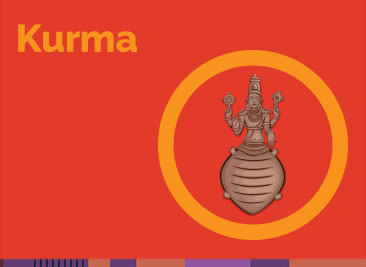
The Tortoise
Master Sculptors | GraniteIt is said that, once, the Gods (Devas) and Demons (Asuras) worked together to churn the cosmic ocean in the search for Amrit (the nectar of immortality). During the Samudra Manthan, the Mount Mandara, which was being used as the churning rod, started to sink. Water levels started to rise, putting the entire universe in danger. To protect creation, Lord Vishnu had to take on the form of a giant tortoise to support the mountain. This was Kurma, the second of the legendary Dasavatarams.
The Kurma form has been interpreted in solid green granite and is located next to the water stream along the Periya Therru in the centre.
The Boar
Master Sculptors | Granite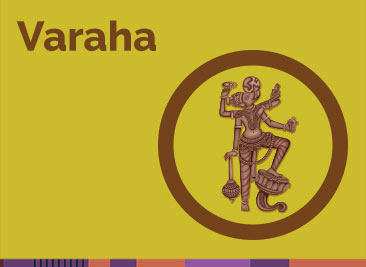
Lord Vishnu appears as a boar to rescue the Goddess of Earth (Bhudevi) from sinking into the great ocean. The demon Hiranyaksha torments the goddess and pulls her to the great depths of the primordial waters. Varaha, the brave and mighty boar, descends to the bottom of the ocean, slays the demon, and emerges carrying the Goddess on his tusks, thus saving the universe from destruction.
The interpretation of the Varaha form can be seen as the head of a boar on the spout of a solid stone granite fountain. Located in the Periya Theru at VR Chennai.
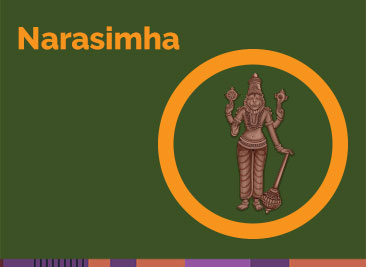
The Lion
Cholamandal Artists' Village | Acrylic Paint BlendThe demon Hiranyakashipu attains a special boon making him indestructible by any demon, god, man or animal, inside or outside, in the day or in the night. Consumed by this power, the demon begins to persecute all devotees of Vishnu. In order to protect his devotees, Vishni takes the avatar of Narasimha, neither demon, god, animal nor man, and appears from a pillar that is neither inside nor outside. He then kills Hiranyakashipu at twilight, the junction of night and day, and restores peace in the universe.
The Narasimha is depicted in the form of a mural in the airlock lobby. The location of the avatar is a nod to the legend of being neither inside nor outside. The mural has been hand painted by the artists of the Cholamandal Artist's Village on the roof in the air pocket accessed through Uloka Gopuram.
The Dwarf
Cholamandal Artists' Village | Acrylic Paint Blend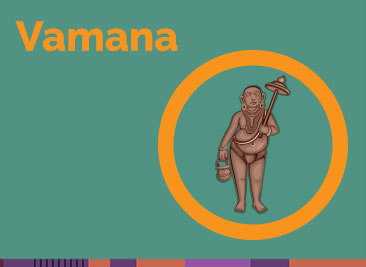
Lord Vishnu appears as the Vamana avatar to restore the authority of Indra over the heavens from the Asura King Mahabali. In the form of a dwarf, Vishnu asks Mahabali for three paces of land. When the benevolent king grants this simple request, Vamana transforms into a giant, and covers the Heavens and the Earth in two steps. Unable to fulfil his promise, Mahabali offers his head for the third step. Vamana steps on the king's head and grants him immortality for his humility. Mahabali is sent to the netherworld, restoring peace and equilibrium in the universe.
Depicting the moment when Mahabali offers his head to the lord, this avatar is represented as a mural. The mural is 5m (15ft) in height and is hand painted by the artists of Cholamandal Artists' Village along the pathway from the Tamarai Sadhukam towards Mini Therru
Lord Rama with an Axe
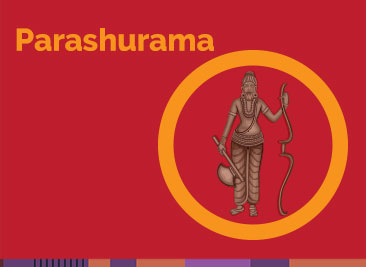
Cholamandal Artists' Village | Acrylic Paint BlendParashurama appears on Earth to save the universe from the violence of the Kshatriya rulers. Affected by the cruel actions of the Kshatriyas, Parashurama swears an oath to end their tyranny. Blinded by anger, he kills all the male Kshatriyas and fills five lakes with their blood. Repenting his actions in retrospect, he gives up all his weapons and worldly possessions, opting for a yogic life.
The mural depicts the moment when Lord Varuna, God of the waters blesses Parashurama while he sat in meditation in Gokarna. The mural is 12m (36 ft) long and is hand painted by the artists of Cholamandal Artist's Village. Located at the Sandhai
Parashurama's Axe
Kalarings Studio | Fibre Reinforced Plastic
An axe was Parashurama's weapon of choice. According to legend, Parashurama threw his axe northward across the ocean from Kanyakumari. As a result, the land of Kerala arose and was re-claimed from the waters.
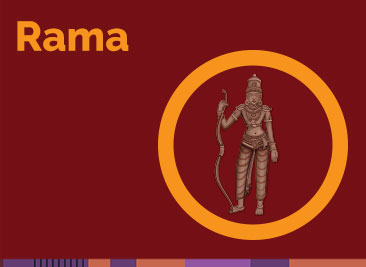
One of Lord Vishnu's most significant avatars, Lord Rama is considered to be the ideal human; one who always does his duty and follows the path of Dharma. His tale is chronicled in one of Ancient India's most famous epics, The Ramayana.
The avatar of Lord Rama has been interpreted as a replica of the main door of the Ramaswamy Temple at the Kannadi Gopuram in the South entrance. The iconic Ramaswamy Temple was constructed by Govinda Dikshitar, Prime Minister to the Nayak rulers, during the 16th century.
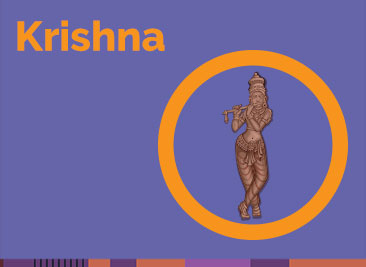
Here you will find tales from different parts of his life, as mentioned in ancient scriptures. Also represented is his sermon to the Pandava prince Arjuna from the epic Mahabharata which forms the holy Bhagavat Gita.
The avatar is interpreted through carvings on the Kannadi Gopuram at the South entrance, depicting poems and scenes from three stages of Lord Krishna's life; his childhood, his youth and the crucial role he plays in the epic battle of Mahabharata as Arjuna's advisor and charioteer.
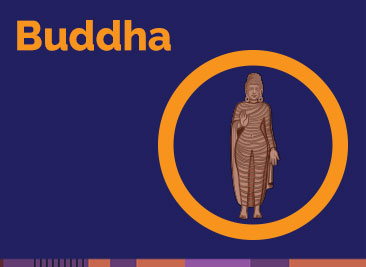
Born Siddhartha Gautama, this avatar was a Shakya prince who attained enlightenment after undergoing many trials and tribulations. The teachings of the Buddha talk about the importance of dharma, duty and sacrifice. In Hinduism his portrayal varies from a proponent of Vedic knowledge to the protector of animals. His teachings urge us to lead a more evolved life of thinking and reflection.
Standing at 2.3m (7 ft6 in), this sculpture is a part of the five Bodhisattva installations by Satish Gupta and is located on the Third Floor. The sculpture depicts that we are all bodhisattva beings.
The Saviour
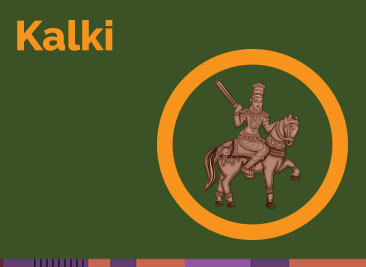
Kalarings Studio | Metal WireKalki, is predicted to appear at the end of Kali Yuga, as the nemesis of the demon Kali. Under Kali's influence, mankind falls to an era of disharmony where untruths prevail, and evil is rampant. Lord Vishnu must finally appear once again to save the world from a deepening crisis in the future. After the destruction of all evil, he will usher in the Satya Yuga, an era of peace and truth, once again.
Represented in abstract sketchy wires forms Palam Therru, this interpretation is an ode to the Puranas tale of the coming of Kalki, atop a white horse with a sword in hand.
Disclaimer: Photos & certain artwork used on www.vrchennai.com are copyright protected and are the property of their respective owners. Brand logos & other trademarks used herein are the property of their respective owners.